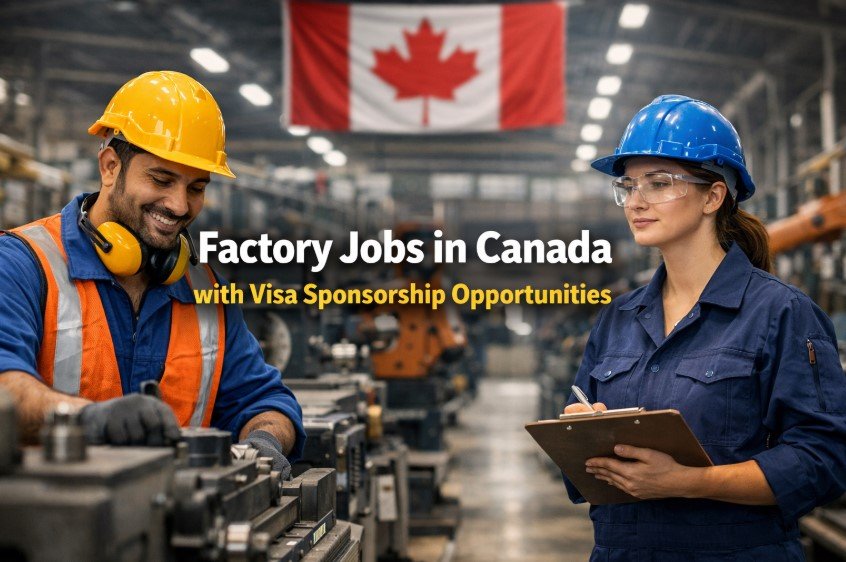
Finding factory jobs in Canada with visa sponsorship opportunities has become a primary goal for many skilled and unskilled workers looking to relocate to North America in 2026.
As the Canadian manufacturing sector continues to expand, many employers are turning to the Temporary Foreign Worker Program (TFWP) to fill critical labor shortages in production lines and processing plants.
Securing factory jobs in Canada with visa sponsorship opportunities is more than just a career move; it is a pathway to a new life in a country known for its high standard of living and inclusive culture.
Whether you are an experienced machine operator or looking for entry-level general labor positions, the Canadian industrial landscape offers a variety of roles that include the necessary legal support to work abroad.
Why Choose Factory Jobs in Canada?
Choosing to pursue factory jobs in Canada with visa sponsorship opportunities is a strategic decision that offers far more than just a steady paycheck. As the manufacturing landscape evolves in 2026, the incentives for international workers have reached an all-time high.
From financial stability to long-term legal residency, here is an in-depth look at why this career path is a top choice for global job seekers.
Highly Competitive Wages and Financial Growth
One of the most immediate benefits of working in the Canadian manufacturing sector is the attractive pay scale. In 2026, the average hourly rate for factory roles typically starts at $18 to $22 CAD, with specialized machine operators or team leads earning upwards of $30 to $35 CAD per hour.
When you factor in overtime, which is common in high-demand production cycles, many workers find they can earn a substantial income that allows for both a comfortable life in Canada and the ability to send money back to their home countries.
Furthermore, annual bonuses and profit-sharing programs are standard in many large-scale industrial plants, providing an extra layer of financial security.
Comprehensive Healthcare and Social Benefits
Canada is world-renowned for its social safety net, and factory employees are prime beneficiaries. When you secure a sponsored position, you aren’t just getting a job; you are gaining access to a system that prioritizes your well-being.
Most employers provide “extended health benefits” which cover costs that the basic provincial healthcare might not, such as prescription drugs, dental care, and physiotherapy.
Additionally, working in Canada means you contribute to and eventually benefit from the Canada Pension Plan (CPP) and Employment Insurance (EI), ensuring that you are protected in case of illness, injury, or future retirement.
Direct Pathways to Permanent Residency (PR)
For many, the ultimate goal of finding factory jobs in Canada with visa sponsorship opportunities is to move from a temporary work permit to becoming a Permanent Resident.
The Canadian government has specifically designed programs like the Canadian Experience Class (CEC) and various Provincial Nominee Programs (PNP) to reward those who have contributed to the local labor market.
By gaining just one year of full-time work experience in a Canadian factory, you often meet the primary criteria to apply for PR. New “sector-specific” draws have been introduced to fast-track workers in essential industries like food processing and advanced manufacturing, making the jump to residency faster than ever before.
Advanced Skill Development and Industry 4.0 Training
The Canadian manufacturing sector is currently undergoing a massive technological shift known as “Industry 4.0.” This means factories are integrating robotics, AI, and smart automation into their production lines. For a worker, this is an incredible opportunity for “upskilling.”
Employers who sponsor foreign workers are often invested in their long-term success and provide hands-on training for operating sophisticated machinery.
Gaining experience in a modern, tech-driven Canadian plant makes you a highly valuable asset globally, ensuring that your skills remain relevant in an increasingly automated world.
A Safe, Inclusive, and High-Quality Work Environment
Beyond the technical and financial aspects, the “human” side of working in Canada is a major draw. Canadian labor laws are among the strictest in the world regarding worker safety and workplace rights.
Every factory must adhere to rigorous Occupational Health and Safety (OHS) standards to ensure that your work environment is as safe as possible.
Moreover, Canadian culture is rooted in diversity and multiculturalism. In a typical Canadian factory, you will likely work alongside people from dozens of different countries, creating a supportive community that helps newcomers integrate more easily into their new lives.
Understanding “Visa Sponsorship” in the Canadian Context
To truly appreciate the value of factory jobs in Canada with visa sponsorship opportunities, one must first understand the legal mechanics that make these international hires possible.
In Canada, visa sponsorship is not a simple “handshake agreement” but a regulated process involving several government bodies to ensure that both the foreign worker and the Canadian labor market are protected.
Here is a deep dive into the core components of the sponsorship system in 2026.
The Labour Market Impact Assessment (LMIA) Explained
The backbone of most factory jobs in Canada with visa sponsorship opportunities is a document called the Labour Market Impact Assessment (LMIA). This is a formal application submitted by the Canadian employer to Employment and Social Development Canada (ESDC).
The purpose of the LMIA is to prove that hiring a foreign worker will have a “positive” or “neutral” effect on the local economy.
For a factory to get approval, they must demonstrate that they actively advertised the position to Canadian citizens and permanent residents for at least four weeks but were unable to find a qualified local candidate.
When you see a job posting that mentions “LMIA-supported,” it means the employer has already done this heavy lifting, significantly clearing the path for your work permit.
The Temporary Foreign Worker Program (TFWP)
Most industrial and manufacturing roles fall under the Temporary Foreign Worker Program (TFWP). This program is specifically designed to address immediate labor shortages in sectors that are critical to Canada’s supply chain, such as food processing and automotive manufacturing.
Under this program, the “sponsorship” acts as a bridge: the employer provides the job offer and the approved LMIA, which you then use to apply for an Employer-Specific Work Permit. This type of permit tethers your legal status to that specific employer.
While this may sound restrictive, it actually provides a high level of security, as the employer is legally obligated to provide you with the exact wages, hours, and working conditions outlined in the original agreement.
High-Wage vs. Low-Wage Sponsorship Streams
Canada categorizes sponsored factory roles based on the provincial median wage. If a factory job pays at or above the median wage, it falls under the High-Wage Stream, which often requires the employer to submit a “Transition Plan” showing how they intend to eventually reduce their reliance on foreign workers (e.g., through training locals).
Conversely, many entry-level production roles fall under the Low-Wage Stream. In 2026, the government has set specific “caps” on how many low-wage foreign workers a factory can employ, typically 10% to 20% of their workforce, to ensure a healthy balance of staff.
Understanding which stream your job falls into is vital, as it dictates the length of your work permit and the specific benefits your employer must provide, such as round-trip transportation costs.
Employer Obligations and Worker Protection
A key part of “sponsorship” in Canada is the strict accountability placed on the employer. Unlike in many other countries, a Canadian employer sponsoring a foreign worker is subject to regular inspections.
They must prove that they are paying the prevailing wage (the average salary for that role in that specific region) and providing a workplace free of abuse or hazards. The Recognized Employer Pilot (REP) has also been expanded, allowing trusted manufacturers with a clean history of compliance to enjoy faster processing times.
This system ensures that when you accept one of these factory jobs in Canada with visa sponsorship opportunities, you are entering a workplace that is legally mandated to treat you with dignity and fairness.
Transitioning to the Provincial Nominee Program (PNP)
While “sponsorship” usually starts with a temporary work permit, it often evolves into a permanent sponsorship through the Provincial Nominee Program (PNP).
Many provinces have specific “In-Demand Skills” streams that allow factory workers to be nominated for Permanent Residency after they have completed a few months of work. In this context, the employer’s “sponsorship” continues by providing a permanent job offer and supporting your provincial application.
This is a crucial distinction: the initial visa gets you through the door, but the ongoing employer-employee relationship is often the key that unlocks a lifelong future in Canada.
Factory Jobs in the Canada with Visa Sponsorship Opportunities
Finding factory jobs in Canada with visa sponsorship opportunities is a pursuit that spans many specialized niches within the industrial sector.
The demand for labor has shifted toward roles that blend traditional manual skills with technological literacy. Below is an extensive look at some specific factory roles currently offering sponsorship pathways for international applicants.
1. Machine Operator
Average Salary: $35,100 – $48,000 per year
Securing factory jobs in Canada with visa sponsorship opportunities as a Machine Operator involves overseeing the complex equipment that forms the backbone of modern production.
These professionals are responsible for setting up, calibrating, and troubleshooting various industrial machines, ensuring that every unit produced meets specific dimensions and quality standards.
Because many Canadian plants are adopting high-tech automated systems, employers are frequently looking abroad for operators who have experience with computerized numerical control (CNC) or programmable logic controllers (PLC).
Beyond simple operation, you will be expected to conduct routine maintenance and perform safety checks, making this a highly valued role that offers a stable path toward permanent residency through various provincial economic streams.
2. Food and Beverage Processing Labourer
Average Salary: $32,448 – $52,000 per year
The food processing sector is one of the most reliable sources of factory jobs in Canada with visa sponsorship opportunities due to its status as an “essential industry.”
Workers in this role handle the primary stages of food production, which can include everything from meat processing and vegetable cleaning to the operation of large-scale industrial ovens and mixing vats.
These positions are often found in both large urban centers and smaller rural communities where local labor is scarce, leading many employers to aggressively use the Temporary Foreign Worker Program.
While the work is physically demanding and often takes place in temperature-controlled environments, it is a primary gateway for entry-level workers to establish themselves in the Canadian workforce.
3. Industrial Welder
Average Salary: $43,680 – $92,706 per year
Welders represent a highly skilled segment of factory jobs in Canada with visa sponsorship opportunities, especially within heavy manufacturing and metal fabrication.
This role requires the ability to use specialized equipment to fuse metal parts together based on complex blueprints and engineering specifications.
Because welding is a regulated trade in Canada, many sponsored positions are aimed at “Journeyman” level workers or those with documented international certifications.
The compensation reflects the high level of technical skill required, and for many foreign workers, a stint as an industrial welder provides the perfect foundation for a successful application to the Federal Skilled Trades Program.
4. Material Handler
Average Salary: $37,000 – $57,000 per year
In the logistics-heavy landscape of 2026, material handlers are the vital link between the production floor and the shipping dock. These factory jobs in Canada with visa sponsorship opportunities focus on the efficient movement of raw materials and finished goods within a facility.
You will be tasked with loading and unloading trucks, organizing inventory using digital tracking systems, and ensuring that assembly lines never run out of the components they need.
While often seen as an entry-level position, modern material handling requires a high degree of organizational skill and the ability to operate specialized equipment like power jacks and reach trucks, making it a multifaceted role with great growth potential.
5. Quality Assurance (QA) Inspector
Average Salary: $45,240 – $105,000 per year
Quality control is the final gatekeeper in any manufacturing process, and QA inspectors are currently in high demand for factory jobs in Canada with visa sponsorship opportunities.
These professionals use precision measuring tools and visual inspection techniques to ensure that products meet both the company’s internal standards and Canada’s strict federal safety regulations. This role is ideal for individuals with a sharp eye for detail and an analytical mind.
Because the consequences of a faulty product can be severe, employers often look for international candidates who have a background in engineering or previous experience in highly regulated manufacturing sectors like pharmaceuticals or aerospace.
6. Forklift Operator
Average Salary: $37,050 – $58,000 per year
Finding factory jobs in Canada with visa sponsorship opportunities as a forklift operator is common in massive distribution hubs and production plants.
The job involves much more than just driving; it requires a deep commitment to safety and the precision to maneuver heavy loads in tight, fast-paced environments.
Most sponsored roles will require you to obtain a Canadian-recognized forklift certification shortly after arrival, though many employers include this as part of their onboarding training.
Because this role is critical for the “just-in-time” manufacturing processes used today, reliable forklift operators are often kept on long-term contracts, providing a clear route to extended work permits and eventual residency.
7. Chemical Plant Operator
Average Salary: $37,128 – $72,800 per year
For those with a background in science or chemical processing, these factory jobs in Canada with visa sponsorship opportunities offer a specialized career path. Operators in this field monitor and control the machinery used to blend, react, and package chemical products ranging from household cleaners to industrial fertilizers.
Safety is the absolute priority here, as you will be dealing with potentially hazardous materials and high-pressure systems.
Employers in this sector are highly inclined to sponsor foreign workers with specific technical diplomas or experience in industrial chemistry, as these skills are often in short supply within the local Canadian labor pool.
8. Assembly Line Worker
Average Salary: $35,000 – $74,000 per year
The classic assembly line remains a powerhouse of the Canadian economy, offering numerous factory jobs in Canada with visa sponsorship opportunities. These roles involve the repetitive but precise assembly of parts into finished products, such as electronics, home appliances, or machinery.
The “Assembly Line Worker” title often includes the use of robotic assists, meaning you will need a blend of physical stamina and the ability to interface with digital interfaces.
These positions are frequently available in “high-volume” manufacturing facilities that have a constant need for a large workforce, making them some of the most accessible roles for those seeking an LMIA-supported job offer.
9. Warehouse Associate
Average Salary: $31,200 – $44,850 per year
Warehouse associates are essential for the storage and distribution components of the manufacturing cycle, making them a staple of factory jobs in Canada with visa sponsorship opportunities.
Your daily tasks would involve picking orders, packing items for shipment, and maintaining the digital inventory records that keep the factory running smoothly.
This role is often a stepping stone; many foreign workers start as warehouse associates and, with the support of their sponsoring employer, eventually move into supervisory or specialized logistics roles. The focus here is on speed and accuracy, as you are the final link between the factory and the customer.
10. Industrial Millwright (Maintenance Mechanic)
Average Salary: $58,500 – $100,000 per year
The millwright is perhaps the most critical technician in any plant, and consequently, these are some of the most sought-after factory jobs in Canada with visa sponsorship opportunities.
Millwrights are responsible for installing, dismantling, and repairing the heavy machinery that fills the factory floor. If a machine breaks down, the millwright is the person who gets production back on track.
Because this is a Red Seal (highly skilled) trade in Canada, the sponsorship process is often very favorable, as the Canadian government prioritizes the entry of skilled mechanics who can keep the nation’s industrial infrastructure operational.
11. Industrial Electrician
Average Salary: $58,677 – $109,013 per year
Similar to millwrights, industrial electricians occupy a high-skill tier among factory jobs in Canada with visa sponsorship opportunities.
They handle the complex electrical systems, wiring, and control panels that power industrial equipment. This role is not just about fixing lights; it involves working with sophisticated robotics and high-voltage systems.
Because of the technical complexity and the safety risks involved, employers are willing to pay a premium and navigate the legal hurdles of visa sponsorship to secure qualified electricians from overseas. This is a “future-proof” career path as factories become increasingly electrified and automated.
12. Industrial Packer
Average Salary: $28,519 – $39,141 per year
Industrial packers provide the finishing touch in the manufacturing process, ensuring that products are safely and correctly prepared for the journey to the consumer.
These factory jobs in Canada with visa sponsorship opportunities are particularly prevalent in the consumer goods and pharmaceutical sectors. While the pay scale is on the lower end compared to specialized trades, the role is often less physically taxing than general labor and provides an excellent entry point into the Canadian job market.
Employers looking for packers often prioritize reliability and attention to detail over formal education, making it a viable option for a wide range of international applicants.
13. Textile Production Worker
Average Salary: $35,000 – $45,000 per year
The Canadian textile industry, while smaller than it once was, has seen a resurgence in the production of specialized technical fabrics and high-end apparel.
This has created a niche for factory jobs in Canada with visa sponsorship opportunities for those with experience in industrial sewing, fabric cutting, and loom operation.
Many of these factories are located in areas with a long history of garment manufacturing, where employers are eager to find workers who possess the traditional craftsmanship skills that are becoming rarer in the domestic workforce.
14. Automotive Assembler
Average Salary: $42,640 – $78,312 per year
Canada is a global leader in vehicle manufacturing, and factory jobs in Canada with visa sponsorship opportunities in the automotive sector are highly coveted.
As an automotive assembler, you might work on the frame of a car, install complex interior electronics, or work in the engine assembly plant. These roles are typically unionized and offer some of the best benefits and job security in the country.
Given the transition to Electric Vehicles (EVs) in 2026, many plants are actively recruiting international workers with experience in battery technology and electric motor assembly, offering a clear and high-paying pathway to a life in Canada.
Conclusion
Securing factory jobs in Canada with visa sponsorship opportunities represents a life-changing chance to build a stable, prosperous future in one of the world’s most welcoming nations. By understanding the LMIA process, targeting high-demand roles like machine operation or food processing, and utilizing official government resources, you can successfully navigate the path from applicant to Canadian resident.