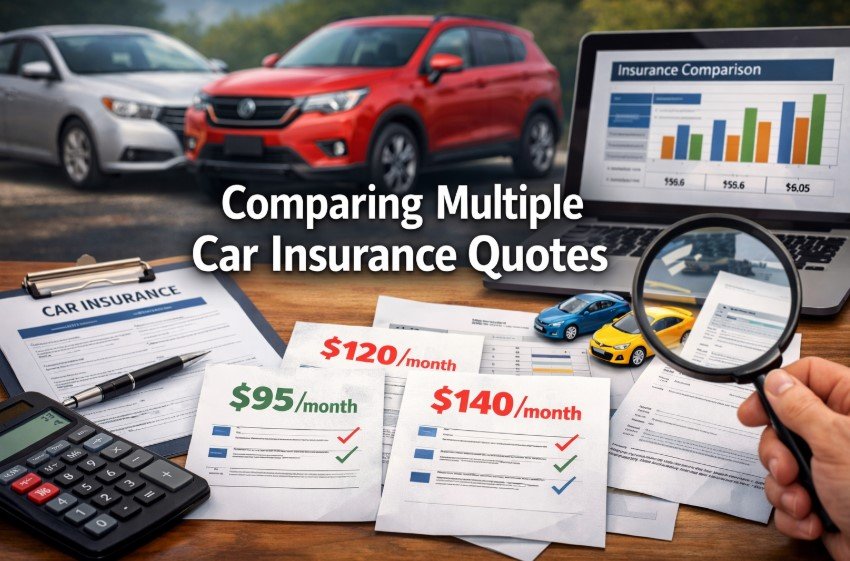
Comparing Multiple Car Insurance Quotes is the single most effective way to ensure you aren’t overpaying for your peace of mind on the road.
Comparing Multiple Car Insurance Quotes allows you to see the vast differences in how insurance companies weigh risk, often revealing hundreds of dollars in potential savings for the exact same level of protection.
While many drivers settle for the first renewal notice they receive or the first “big name” brand they see on television, savvy vehicle owners know that the market is constantly shifting.
By taking a systematic approach to Comparing Multiple Car Insurance Quotes, you can navigate the complexities of premiums, deductibles, and coverage limits to find a policy that fits both your budget and your lifestyle perfectly.
Why Comparing Multiple Car Insurance Quotes is Essential
Comparing Multiple Car Insurance Quotes is the only way to bypass the “loyalty penalty” that many long-term policyholders unknowingly pay.
While it might seem convenient to let your policy auto-renew, insurance companies frequently adjust their pricing models based on shifting market data, inflation, and their own financial performance.
By Comparing Multiple Car Insurance Quotes, you effectively force the market to show its hand, ensuring that you are not being charged yesterday’s prices for today’s risks.
Uncovering Vast Price Discrepancies for Identical Coverage
One of the most eye-opening aspects of Comparing Multiple Car Insurance Quotes is discovering just how much two companies can differ in price for the exact same level of protection.
Because every insurance provider uses a proprietary “secret sauce” algorithm to determine risk, one company might view your specific profile, your age, vehicle, and credit score, as low-risk, while another might see it as high-risk.
For instance, a driver might receive a quote of $800 from one insurer and $1,400 from another for the same $100,000/$300,000 liability limits. Without the act of comparing, you would never know that hundreds of dollars are being left on the table simply because of an algorithm’s preference.
Identifying Niche Discounts Tailored to Your Lifestyle
Every insurer has a different target demographic, and they offer specialized discounts to attract those specific drivers. When you are Comparing Multiple Car Insurance Quotes, you gain exposure to a wider variety of “hidden” savings that your current provider may not offer.
Some companies specialize in “telematics,” offering deep discounts to safe drivers who use a monitoring app, while others might offer significant price cuts for members of certain professional organizations, alumni associations, or the military.
By looking at a broad spectrum of quotes, you can find the insurer whose discount structure most closely aligns with your personal life and habits, resulting in a much lower bottom line.
Protecting Against Stealth Premium Hikes (Price Walking)
“Price walking” is a term used to describe the practice where insurers slowly raise premiums on loyal customers over time, betting on the fact that the customer won’t take the time to look elsewhere. Comparing Multiple Car Insurance Quotes serves as a vital defensive maneuver against this trend.
Even if you haven’t had an accident or a ticket, your rates can creep up due to “inflationary adjustments” or “regional risk shifts.” By conducting a yearly comparison, you send a clear signal to the industry that you are a savvy consumer.
If your current insurer sees you shopping around, or if you find a lower rate elsewhere, you gain the leverage needed to switch or negotiate, preventing your hard-earned money from being absorbed by corporate “creep.”
Evaluating Variations in Claims Reputation and Service Quality
While the price tag is important, Comparing Multiple Car Insurance Quotes is also a qualitative exercise that helps you gauge the health and reliability of a company. A quote isn’t just a number; it is a promise of future service.
During the comparison process, you can look beyond the premium to research “Claim Settlement Ratios” and customer satisfaction scores.
You might find that a slightly more expensive policy is actually a better value because the insurer has a reputation for paying claims in 48 hours rather than 48 days.
Comparing multiple providers allows you to weigh the financial cost against the “peace of mind” cost, ensuring that you don’t end up with a “budget” policy that fails you when you’re stranded on the side of the road.
Adapting to Major Life Milestones and Changes
Your life is not static, and your insurance shouldn’t be either. Comparing Multiple Car Insurance Quotes is essential whenever you experience a major life event, such as getting married, moving to a new ZIP code, or improving your credit score.
An insurer that was perfect for you as a single renter might be the most expensive option once you become a married homeowner who wants to bundle policies.
Similarly, if you’ve recently reached the age of 25, many companies will drastically lower your rates, but only if you ask or shop around. Regularly comparing quotes ensures that your insurance “skin” grows with you, reflecting your current status rather than who you were five years ago.
Discovering Superior “Add-On” Benefits and Perks
Not all policies are created equal, and Comparing Multiple Car Insurance Quotes reveals the “extras” that can make a huge difference in an emergency.
Some insurers include “Accident Forgiveness” or “Vanishing Deductibles” as standard features, while others charge a premium for them. Others might offer free roadside assistance, glass repair without a deductible, or even “New Car Replacement” coverage.
When you look at multiple quotes side-by-side, you can see which company offers the most “value-added” features for your dollar.
This holistic view prevents you from buying a “hollow” policy that only meets the legal minimums, allowing you to build a robust safety net that actually serves your needs.
The Pre-Comparison Checklist: What You Need
Comparing Multiple Car Insurance Quotes is a data-driven process that requires a high level of accuracy to be successful. If you provide vague or incorrect information to an insurer, the price you are quoted will likely change, often for the worse, once the company runs your official reports.
To ensure that Comparing Multiple Car Insurance Quotes yields the most realistic results, you must gather your “proof” before you start filling out forms or talking to agents.
Comprehensive Personal and Household Driver Profiles
The first pillar of Comparing Multiple Car Insurance Quotes is providing an exhaustive list of everyone in your home who has a driver’s license. Insurers don’t just care about you; they care about the “household risk,” which includes roommates, spouses, and driving-age children who have access to your keys.
For each person, you will need their full legal name, date of birth, and their driver’s license number. It is also helpful to know the specific year they first received their license, as “years of driving experience” is a major factor in how companies calculate your premium.
Providing this information upfront prevents “sticker shock” later when the insurance company discovers an undisclosed driver in your household during the underwriting process.
Detailed Vehicle History and Identifying Information
When you are Comparing Multiple Car Insurance Quotes, your car’s specific “fingerprint” matters more than just its make and model. You should have your 17-character Vehicle Identification Number (VIN) ready for every car you intend to insure.
While a generic “2022 Toyota Camry” quote will give you a ballpark figure, a VIN-specific quote allows the insurer to see exactly which trim level and safety packages your car has, such as lane-departure warnings or advanced anti-theft systems, which often trigger automatic discounts.
Additionally, you’ll need to know your current odometer reading and be prepared to provide the address where the vehicle is parked overnight, as garaging location is a primary factor in theft and accident risk assessment.
Accurate Driving and Claims Records for the Last Five Years
Honesty is the best policy when Comparing Multiple Car Insurance Quotes, especially regarding your driving history. You should compile a list of any speeding tickets, at-fault accidents, or comprehensive claims (like hail damage or a cracked windshield) that have occurred within the last three to five years.
Don’t rely on memory alone; try to find the exact dates of these incidents. If you omit a minor fender-bender while Comparing Multiple Car Insurance Quotes, the insurer will find it anyway when they pull your “CLUE” (Comprehensive Loss Underwriting Exchange) report, and your final premium will jump.
Knowing your history allows you to find “forgiving” insurers who may weigh older, minor incidents less heavily than their competitors.
Your Current “Declarations Page” as a Baseline
You cannot effectively engage in Comparing Multiple Car Insurance Quotes without a clear understanding of your current coverage.
Your “Declarations Page” (or “Dec Page”) is the summary document provided by your current insurer that lists your specific coverage limits, such as $50,000 for property damage or $100,000 for bodily injury.
By having this document in front of you, you can ensure that every new quote you request matches these limits exactly.
This is the only way to know if a lower price is actually a better deal or if the new company is simply offering you less protection. It also serves as “Proof of Prior Insurance,” which is a requirement for many discounts given to drivers who have maintained continuous coverage without any gaps.
Financial and Usage Details for Customization
The final step in your checklist for Comparing Multiple Car Insurance Quotes involves the “how” and “why” of your daily driving.
You need to estimate your annual mileage accurately; if you’ve switched to a remote work model, your lower mileage could save you a fortune, but you have to specify it during the quote process.
Furthermore, if you are still paying off a car loan or have a lease, you must have the name and address of your lienholder or leasing company.
These institutions often require you to carry specific high-limit coverage (like Gap Insurance or lower deductibles), and including these requirements while Comparing Multiple Car Insurance Quotes ensures your new policy remains in compliance with your financing agreement.
Understanding the “Apples-to-Apples” Comparison
Comparing Multiple Car Insurance Quotes is only effective if you are holding every variable constant except for the price.
If you look at one quote with a $500 deductible and another with a $1,000 deductible, you aren’t actually comparing the value of the companies; you are comparing two entirely different financial products.
To master the art of Comparing Multiple Car Insurance Quotes, you must act as a scientist, ensuring that the “controls” of your experiment, the coverage types, limits, and deductibles, remain identical across every single estimate you receive.
Standardizing Liability Limits for Personal Protection
The most critical area to hold constant when Comparing Multiple Car Insurance Quotes is your liability coverage. This is the portion of your insurance that pays for damage or injuries you cause to others, and it is usually broken down into three specific numbers (e.g., 100/300/100).
If Quote A uses the state minimum (which might be as low as 25/50/25) and Quote B uses a more robust “standard” limit, Quote A will look significantly cheaper. However, it also leaves you exposed to massive lawsuits if you cause a serious accident.
When Comparing Multiple Car Insurance Quotes, pick a limit that truly protects your assets, typically $100,000 per person and $300,000 per accident, and enter those exact numbers into every single quote form to see which insurer handles that specific level of risk most affordably.
Matching Deductibles Across Collision and Comprehensive
Deductibles are the “levers” that insurers use to move your premium up or down, and they are a frequent source of confusion when Comparing Multiple Car Insurance Quotes. A deductible is the amount you pay out of pocket before the insurance company covers the rest.
If you are comparing a policy from Company X that has a $250 deductible against a policy from Company Y that has a $1,000 deductible, Company Y will almost always win on price. But that price advantage is an illusion, you’re simply agreeing to take on $750 more of the risk yourself.
For a true “apples-to-apples” look while Comparing Multiple Car Insurance Quotes, decide on one deductible amount (like $500) and apply it to both Collision and Comprehensive coverage for every inquiry.
Aligning Optional Coverages and Endorsements
The “fine print” of a policy often contains small add-ons that can skew the total cost when you are Comparing Multiple Car Insurance Quotes. These include things like roadside assistance, rental car reimbursement, glass breakage coverage, and gap insurance.
One insurer might include roadside assistance as a “free” perk, while another charges $15 per month for it. If you don’t account for these, you might choose a policy that seems cheaper but lacks the daily conveniences you rely on.
As you go through the process of Comparing Multiple Car Insurance Quotes, keep a running list of these “extras” and either include them in every quote or exclude them from all of them so you can see the “raw” premium cost clearly.
Verifying Policy Terms and Payment Frequencies
Time is a factor that often gets overlooked when Comparing Multiple Car Insurance Quotes. Most car insurance policies are written for either a six-month term or a twelve-month term.
If you aren’t paying attention, you might accidentally compare a six-month premium from one company to a twelve-month premium from another, leading to a massive mathematical error.
Furthermore, many companies offer a “pay-in-full” discount. When Comparing Multiple Car Insurance Quotes, check if the price you are seeing assumes a monthly payment plan (which often includes interest or installment fees) or a single lump-sum payment.
Ensuring the “timeframe” and “payment method” are consistent is the final step in achieving a perfect, unbiased comparison.
Types of Coverage to Evaluate when Comparing Multiple Car Insurance Quotes
Comparing Multiple Car Insurance Quotes requires a deep dive into the specific “buckets” of protection that make up a policy.
While most people think of car insurance as a single entity, it is actually a collection of different coverages, each designed to protect you from a specific type of financial loss.
By Comparing Multiple Car Insurance Quotes with a focus on these individual components, you can “mix and match” your protection levels, ensuring you aren’t paying for redundant coverage while simultaneously filling dangerous gaps in your safety net.
Liability Insurance
When you begin Comparing Multiple Car Insurance Quotes, the first thing you will encounter is Liability coverage. This is the bedrock of your policy because it protects your personal assets (like your savings and your home) from being seized if you are sued after an accident.
It is split into two parts: Bodily Injury Liability, which pays for the medical bills and lost wages of others, and Property Damage Liability, which pays to repair or replace the other person’s vehicle or property.
Because different insurers have different “appetites” for high-liability risks, Comparing Multiple Car Insurance Quotes is the only way to see which company offers the highest limits for the lowest cost, allowing you to carry $250,000 or $500,000 in protection without breaking the bank.
Collision and Comprehensive
While liability protects your wallet from other people, Collision and Comprehensive coverages protect your own vehicle.
Collision coverage pays to fix your car after a crash, regardless of who was at fault, while Comprehensive coverage (often called “other than collision”) protects you against “acts of God” like hailstorms, floods, fire, or hitting a deer.
When Comparing Multiple Car Insurance Quotes, pay close attention to how each company values your vehicle. Some may offer “Actual Cash Value,” while others might offer “Replacement Cost” for newer cars.
Comparing Multiple Car Insurance Quotes allows you to see if the price of protecting your car’s physical value is worth the premium, especially if you drive an older vehicle where the cost of the insurance might eventually exceed the value of the car itself.
Uninsured and Underinsured Motorist Protection
One of the most overlooked aspects of Comparing Multiple Car Insurance Quotes is protection against other drivers who are irresponsible.
Despite legal requirements, millions of people drive without insurance or with the bare legal minimums that wouldn’t cover a minor fender-bender in today’s economy.
Uninsured Motorist (UM) and Underinsured Motorist (UIM) coverage step in to pay your medical bills and repair costs if you are hit by someone who can’t pay.
As you are Comparing Multiple Car Insurance Quotes, you’ll find that the cost of adding this coverage varies wildly between providers. Some insurers see this as a low-risk add-on, while others price it higher based on regional data regarding uninsured driver rates.
Medical Payments (MedPay) and Personal Injury Protection (PIP)
Depending on where you live, you may need to evaluate “no-fault” coverages like MedPay or PIP when Comparing Multiple Car Insurance Quotes.
These coverages are designed to pay for medical expenses for you and your passengers immediately after an accident, regardless of who caused it. PIP is often more robust, covering not just hospital bills but also lost wages and essential services like childcare if you are incapacitated.
When Comparing Multiple Car Insurance Quotes, look at how these coverages interact with your existing health insurance. If you have a high-deductible health plan, choosing a quote with a higher PIP limit can provide a crucial financial buffer during a recovery period.
Specialty Add-ons: Roadside, Rental, and Gap Insurance
The final layer of Comparing Multiple Car Insurance Quotes involves the “quality of life” coverages that handle the logistics of an accident.
Rental Reimbursement ensures you have a car to drive while yours is in the shop, and Gap Insurance is vital if you owe more on your car loan than the vehicle is worth.
Many drivers find that by Comparing Multiple Car Insurance Quotes, they can find a “premium” carrier that includes roadside assistance and towing for a few dollars a year, which is often much cheaper than a standalone AAA membership.
Evaluating these extras ensures that your comparison isn’t just about the “big” disasters, but also about the small inconveniences that can ruin your week.
Factors That Influence Your Quotes
When you are Comparing Multiple Car Insurance Quotes, you are essentially looking at how different companies interpret your “risk profile.” No two insurers weigh individual factors exactly the same way, which is why your premiums can vary by hundreds of dollars even when the coverage remains identical.
In the more recent times, these calculations have become even more complex as insurers incorporate real-time data, advanced vehicle technology, and shifting economic trends into their pricing models.
The Evolution of Driving Records and Behavior
Your past behavior on the road remains the most influential factor when Comparing Multiple Car Insurance Quotes. Insurers look at a three-to-five-year window of your driving history, focusing on “chargeable” incidents like at-fault accidents, speeding tickets, and DUIs.
However, in 2026, the definition of a “driving record” is expanding. Many companies now offer, or even require, participation in telematics programs that track your braking, acceleration, and cornering in real-time.
When Comparing Multiple Car Insurance Quotes, you may find that some insurers offer a massive “safe driver” discount upfront based on your historical record, while others provide a lower base rate that only stays low if your real-time driving data remains pristine.
Localized Risk and “Hyper-Local” Geography
Geography has always played a role in insurance, but modern data analytics have made it more granular than ever.
When you are Comparing Multiple Car Insurance Quotes, the specific ZIP code, and sometimes the exact neighborhood, where you “garage” your vehicle dictates your baseline risk for theft, vandalism, and weather-related claims.
In recent times, insurers are also factoring in “social inflation” and regional litigation trends; for instance, areas with high rates of insurance-related lawsuits often see higher premiums across the board.
By Comparing Multiple Car Insurance Quotes, you can identify which companies have more favorable data for your specific area, as one insurer might be over-indexed in a high-crime neighborhood while another has a more balanced risk pool.
Credit-Based Insurance Scores and Financial Responsibility
Unless you live in one of the few regions that have banned the practice, your credit history is a major component used when Comparing Multiple Car Insurance Quotes.
Statistical data has shown a high correlation between financial responsibility and road safety, leading insurers to create “credit-based insurance scores.” This is not the same as your FICO score used for loans, but it draws from the same data.
If you have a high score, you are seen as a “stable” risk, which can lead to premiums that are nearly 50% lower than those for drivers with poor credit.
Comparing Multiple Car Insurance Quotes is the only way to see how much weight each company gives to your credit; some insurers are much more “forgiving” of a low credit score than others.
Vehicle Complexity and the “Tech Gap”
In more recent times, the type of car you drive influences your quote in two conflicting ways: safety and repairability.
When Comparing Multiple Car Insurance Quotes, you’ll notice that vehicles equipped with Advanced Driver Assistance Systems (ADAS), like automatic emergency braking and lane-keep assist, often qualify for safety discounts because they are statistically less likely to be in an accident.
However, these same features make even minor fender-benders incredibly expensive to repair, as sensors and cameras embedded in bumpers must be replaced and recalibrated.
Comparing Multiple Car Insurance Quotes helps you navigate this “Tech Gap,” identifying which insurers have adjusted their rates to account for the high cost of modern vehicle parts versus those that still offer “legacy” rates for older, simpler cars.
Annual Mileage and the Shift Toward “Pay-Per-Mile”
How much you drive is a direct multiplier of your risk; every mile spent on the road is another opportunity for an incident. When Comparing Multiple Car Insurance Quotes, your estimated annual mileage can move you into different “rating tiers.”
Drivers who cover fewer than 7,500 miles a year are often eligible for significant low-mileage discounts. In today’s hybrid-work economy, many drivers have seen their mileage drop significantly.
If you are a low-mileage driver, Comparing Multiple Car Insurance Quotes allows you to find specialized “pay-per-mile” or “usage-based” policies that can save you a fortune compared to a traditional “unlimited” policy offered by a standard carrier.
Conclusion
Comparing Multiple Car Insurance Quotes is a straightforward process that rewards diligence with significant savings. By maintaining a consistent profile, understanding your coverage needs, and looking beyond just the monthly premium, you can secure a policy that offers both value and security. Don not just leave your money on the table. Start Comparing Multiple Car Insurance Quotes today and take control of your financial future on the road.